A Cookie and its Consequences
As long as she was alive, my Swedish grandmother baked a traditional Christmas treat she called “Kanel Pinar” for members of her family. Inga lived with us in Illinois when I was growing up but spent winters with another daughter and her family in the more temperate climate of El Paso. Consequently, we reliably received by mail a Christmas tin bulging with a variety of cookies, including my personal favorite, the Kanel Pinar.
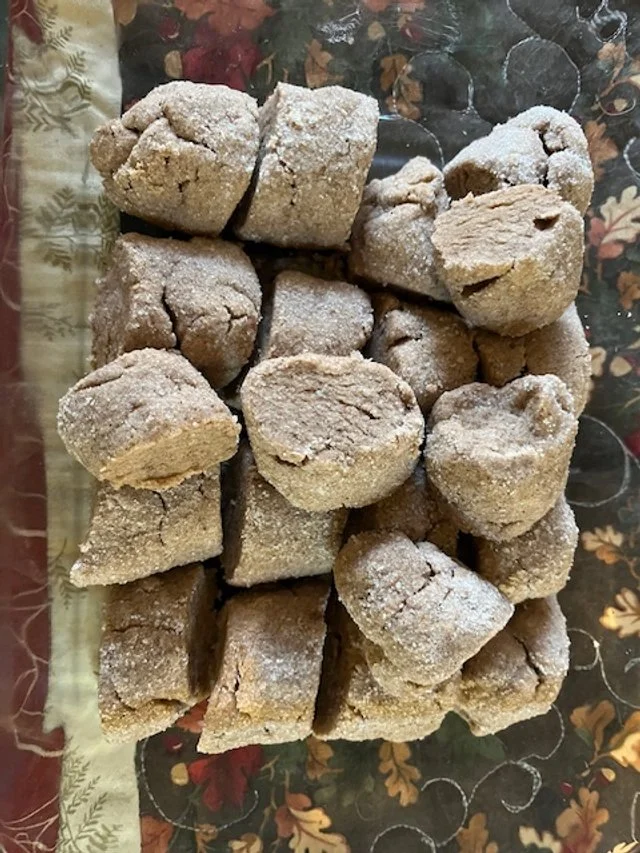
It’s a simple confection to make, consisting of butter, flour, cinnamon, almond extract, and sugar rolled into a log, then sliced into one-inch diagonal sections for baking. With a sandy texture, they’re one of those “melt in your mouth” species of cookie. After Inga expired my mother made Kanel Pinar during the holidays, following her mother’s brief instructions.
Nancy Schuler, in turn, passed away over Thanksgiving two years ago shortly after her one-hundredth birthday, but not before the venerable recipe had passed on to me. A few days ago, I attempted my first batch and can honestly report that they have a taste and mouth feel similar to the original. Curious about its origin, I typed “Kanel Pinar” into my search engine but only came up with another old-fashioned Swedish cookie called a “Kanelkakor,” which seems like a more complicated derivation (this formula includes eggs, baking soda and vanilla extract).
Inga Martinson was the only child of a marriage that ended in divorce. Leaving school after the eighth grade, she married Herman Balster, another product of a broken home whose business acumen led to a successful career in the hospitality industry. Inga took charge of their three daughters, all of whom earned college degrees. After her husband died at age 60 of a massive heart attack, she provided seasonal support for her working daughters and their children. Grandmother Inga cooked, kept house, and gardened (as I highlighted in an earlier blog) for our family five months of the year.
I got to thinking about this otherwise unsung lady upon reading Rebecca Lawton’s moving essay “Considerable Luck” in a recent issue of The Sun. She ends her narrative with a haiku composed by the celebrated Japanese Buddhist poet, Basho:
An autumn night –
Don’t think your life
Didn’t matter.
Grandmother Inga was special to me not just for her cookies, but for a number of other reasons. She never pretended to be more than she was, but that was more than sufficient for her and for us. When mother and I would visit the Acacia Park Cemetery in the Twin Cities, I felt privileged to trim away the grass that had overgrown and obscured the bronze plaque marking her grave.
At the end of the movie “Amadeus” Mozart’s rival, Salieri, terminates a visit from the priest who has come to hear his confession at the insane asylum where he’s been committed with a wry benediction of sorts. Holding his arms aloft, as if bestowing a blessing, he declares, “Mediocrities everywhere, I absolve you, I absolve you.” In addition to goosing the naïve priest, Salieri is making a statement about human worth. For the former court composer in Emperor Joseph II’s service, not to have reached the sublime heights of true genius (e.g., Mozart) reduced one to irrelevancy.
Basho would disagree. Mediocrity isn’t a fact; it’s a value judgement and a putdown. Whether we believe it or not, our otherwise obscure lives – including the life of a Swedish immigrant’s child – do matter, if only because a recipe from the old country reminds a grandson of a hidden legacy of good-hearted caregiving.