Literature to Grow By

“Sustainability isn’t only, or mainly, about light bulbs. It’s about patience and prudence and the other virtues described in this book - it’s about becoming mature as people and as a society. That’s hard work but good work, and this is the manual.”
- Bill McKibben, author of Falter and The End of Nature

Humanism: In Command or in Crisis?
Philosophic humanism advances several important theses: 1. That human interests are paramount (anthropocentrism); that civilization’s best hope lies in the rigorous application of rational thought; that overall the arc of human history is moving in a progressive direction; and, that science and technology can be counted on to produce results that contribute immeasurably to human well-being. Whether they call themselves “humanists” or not, a vast number of people in the developed West - and increasingly in other parts of the world - subscribe to this ideology. But is it working? Scholars and public intellectuals representing various disciplines, including history, biology and ecology, the behavioral sciences, literature, religion, philosophy, and cybernetics are asking important questions and challenging humanism’s core assumptions. Here you will find a cogent explanation and developmental history of humanism, and a comprehensive critique by highly respected commentators. More
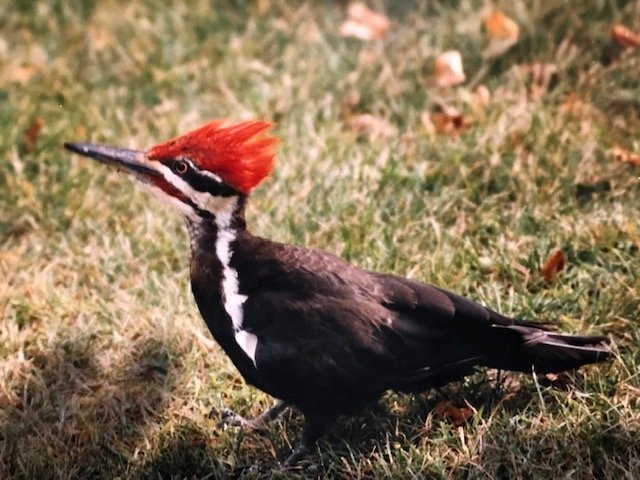
Charles W. Schuler was my father. He passed away in 2019 after a tumultuous three years, pieces of which introduce and set the stage for each of the chapters that follow. This pileated woodpecker is representative of the many nature-oriented photos he took as a younger man
The Curious Man in Suite 604 (A Memoir)
Setting the Scene
This is the story of my father’s last weeks on earth, of which my wife and I - apart from his medical team - were the sole witnesses. But it is also the story of an eventful life, whose peculiar elements were tantalizingly suggested (to those few who knew him well) by what took place during this frail and unrepentant nonagenarian’s final struggle against the inevitable.
Charles William Schuler, who preferred the diminutive “Bill”, died on April 26, 2019 two months short of his 97th birthday. I am the middle son and, as so often happens with those who occupy this position in the birth order, was fated to be entangled in my father’s affairs to a degree far surpassing that of my siblings.
Which is not to say that the “Pater Familias” bestowed greater favors on me than my siblings. Just the opposite, in fact. With an older brother (William Eliot) and a younger sister (Catherine Ann) I often hungered for the level of attention they received. It began with our names. Wasn’t it curious, I thought, that both my siblings were crowned with the appellations of two of my father’s literary heroes (T.S. Eliot and Catherine Ann Porter), while my own name was seemingly pulled out of a hat.
In later years, my mother would laughingly comment on how “observant” I was of our family dynamics, by which she meant that I had a habit of “keeping score.” She was right about that, and at least to some extent this trait grew out of an uneasy childhood realization that our domestic life was fundamentally flawed; that it wasn’t as fair or just as it could have been.
However, this was not an impression shared by my siblings, and despite their own conflicted feelings about our father, at his graveside they both spoke appreciatively (albeit disingenuously) of the “generosity” he had displayed toward all three of us.
Despite, or perhaps because of my insecurity, I strove throughout my growing-up years “to be of use,” as the poet Marge Piercy memorably put it. When a helping hand was needed, I was typically the one Dad called upon because I was both obliging and, generally speaking, reliable. Brother Bill, a bookish introvert, kept to himself and only grudgingly responded to my parents’ importuning. The folks expected little of sister Cathy, she being the soft, emotionally fragile baby girl. As for me, an alternating pattern of quiet resentment and overcompensating eagerness emerged. On most occasions I opted for the latter because it proved less painful. Perhaps my siblings didn’t need parental approval as much as I did and therefore were less motivated to put their shoulders to the wheel.
Disappointingly, my father rarely bestowed a compliment or evinced satisfaction with my efforts (criticism came much easier for him). As a result, I learned the hard way to let the work be its own reward. Was it an inbred northern European reticence, or a conviction that we would be “spoiled” by too many dollops of verbal praise, that prevented both my parents from affirming their children?
More likely, they - and particularly my father – hadn’t benefited from encouragement or praise during their own formative years. My paternal grandfather was beset by his own demons, and his father was legendarily harsh toward his wife and son. Callousness cut a deep furrow on that side of the family.
Mother Nancy (also a middle child, bracketed by two comely and vivacious sisters) didn’t fare quite so badly. Still, her undemonstrative Swedish-German parents offered approbation only sparingly. With little ego strength of her own, Nancy was disposed to bow to any domineering male. More